|
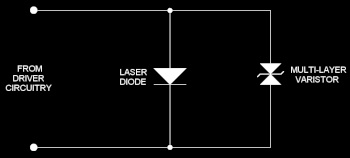 The
figure to the right shows another approach commonly employed to protect a laser diode from
ESD. In this approach a multi-layer varistor is placed in parallel with
the laser diode. A multi-layer varistor is a device whose resistance
changes, decreasing nonlinearly, with increases in voltage that appear
across the terminals. The
figure to the right shows another approach commonly employed to protect a laser diode from
ESD. In this approach a multi-layer varistor is placed in parallel with
the laser diode. A multi-layer varistor is a device whose resistance
changes, decreasing nonlinearly, with increases in voltage that appear
across the terminals.
Although some multi-layer varistors claim to have response times in the
sub-nanosecond
range, their breakdown voltage (the voltage at which the varistor
transitions from high resistance to low resistance) is typically well in
excess of the 2.2-volt lasing threshold, or 2.0-volt maximum reverse-bias
voltage of a typical low-power laser diode. A multi-layer varistor whose
breakdown voltage is below 3.6 volts is not known to us at Lasorb.
Therefore, this approach is not believed to be completely effective in
preventing a low-power, fast-response laser diode from being damaged by
15,000-volt ESD.
|
|
ESD polarity terminology used on this
web site
The term “positive-ESD” is used to
mean electrostatic discharge (ESD) whose voltage polarity would tend
to forward-bias a laser diode. “Negative-ESD,” means ESD whose
voltage polarity would tend to reverse-bias a laser diode. |
|