|
LASORB is an electronic component that is designed specifically to protect laser
diodes from ESD and power surges. LASORB can also be used to protect other
types of optoelectronic devices such as Superluminescent Diodes, LEDs and
Photodiodes.
LASORB overcomes the problems of previously known ESD protection schemes
by preventing reverse-bias of the laser diode. It also prevents ESD
or other power-related faults from exceeding (and in many cases, even
reaching) the maximum forward-bias voltage of the laser diode. LASORB is
able to do this while not adding significant resistance or capacitance to
the laser diode, thereby not complicating the task of driving the laser
diode.
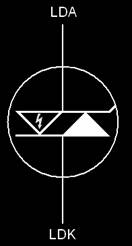
The LASORB circuit symbol
LASORB is connected directly across the terminals of
a laser diode, with the LDA terminal of LASORB connected to the Laser
Diode Anode, and the LDK terminal connected to the Laser Diode Cathode. As shown in the LASORB symbol
below, the LASORB can be
thought of as two separate parts. Each part will be described separately
to aid in a complete understanding of how it works.
Negative ESD (and reverse bias) protection
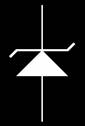 On
the right hand side of the LASORB symbol, you can see the symbol for what
appears to be a Zener diode. On
the right hand side of the LASORB symbol, you can see the symbol for what
appears to be a Zener diode.
This portion of LASORB
prevents negative-ESD – that is, ESD whose polarity would tend to reverse
bias the laser diode. This portion of the LASORB is a made of very fast acting PN
junction.
The forward voltage of this junction will not exceed 2 volts, even during
50-amp ESD events.
The maximum peak inverse voltage of LASORB varies as
a function of the part number, and parts can be customized to operate up
to 20 volts. Above the maximum peak inverse voltage, an “avalanche” condition exists, and,
although not designed to be used this way, no damage will come to the
LASORB as a result of operating it at the avalanche voltage. Since LASORB
can withstand operation at the avalanche voltage, we chose to indicate
this portion of LASORB using the Zener diode symbol.
ESD/power surge protection
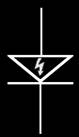 On
the left hand side of the LASORB symbol, you will see the symbol for a new
kind of diode. On
the left hand side of the LASORB symbol, you will see the symbol for a new
kind of diode.
This portion of LASORB is a diode that is triggered
by ESD or power surges. When the voltage at the LDA terminal of LASORB
rises at a high rate when compared to the LDK terminal, the LASORB
activates this special diode, which conducts current and diverts the ESD through the LASORB
instead of allowing it to pass through the laser diode. When activated,
the voltage across this portion of LASORB will not exceed the nominal
operating voltage of the laser diode, even during 50 amp ESD surges.
During normal laser operation, the voltage across
the laser diode normally does not change much, even during
modulation. Because of this, LASORB will remain inactive, presenting only
a slight resistive and capacitive load on the driver. But if an ESD event occurs
while the laser diode is operational, this too will be detected, and the
special diode will once again be triggered, diverting ESD through LASORB
instead of through the laser diode. The theoretical reaction time of LASORB is between
200 and 800 picoseconds, so it is fast enough to react to nanosecond-level
ESD events.
Datasheets
For more detailed information, go to the
Datasheets page.
You can download PDF datasheets on our various LASORB formulations,
optimized for particular types of laser diodes.
|